It’s Valentine’s Day, and who better to give us a definition of the ultimate sexy hero than romance writers? So we asked our clients, What makes your hero sexy? and here’s what they told us. . . .
Kimberly Dean
Book: Taming Him (including "Fever" by Kimberly Dean)
Publisher: Pocket, January 2007
Hero’s Name: Wouldn't you like to know?
What makes the hero in "Fever" sexy? He's got that element of mystery. He shows up in the middle of the night to take care of Delia, but a fever has left her delirious. She's not quite sure who he is, but he's strong, compassionate, and determined to make her feel better . . . any way he can!
*
Kate Douglas
Book: The Wolf Tales Series
Publisher: Kensington/Aphrodisia
Hero’s Name: Anton Cheval
Since I write a series, my characters pop in and out of my stories. Anton Cheval was in the original book and continues to show up in almost all my stories, mainly, I think, because I’m not willing to let him go. Anton is perfect, in my opinion! Physically he’s tall and slim, with long, dark hair and the look of a Russian aristocrat or a classical musician—high cheekbones, a wide, sensual mouth, and those telltale amber Chanku eyes, but I think he could look like a toad and still be sexy. Well...maybe not a TOAD, but . . . :) He’s intelligent—intellectually powerful with the genius of both the wizard and the wolf, yet he’s sensitive and a loving mate to his beloved Keisha. The clincher, however, is his vulnerability, and that, I believe, is the key to a sexy hero. For all his alpha strength, he’s a puddle of goo when it comes to his mate, and now to his infant daughter. His love for them is so powerful it terrifies him. That chink in his armor, the fact he fears for their safety to the detriment of his own, is what makes him so attractive.
*
Deanna Lee
Book: Barenaked Jane
Publisher: Kensington/Aphrodisia, April 2007
Hero’s Name: Mathias Montgomery
He’s strong, determined, and entirely dedicated to the pleasure of his woman. Mathias enters Jane’s life and in one instant every single thing she thought she ever wanted is changed.
*
Sharon Page
Book: Blood Red
Publisher: Kensington/Aphrodisia, January 2007
Hero’s Name: Blood Red has two heroes, the twin brothers Yannick de Wynter, the Earl of Brookshire, and Bastien de Wynter.
Writing two heroes for one heroine (who both win her heart—this is erotic romance, after all), meant creating two unique yet undeniably sexy men who are both vampires. What makes them hot? For my vampires, it’s more than just chiseled bodies, brooding silvery eyes, aristocratic good looks, and their seductive allure. My heroes believe in Althea, their vampire-hunting heroine, and they challenge her. Yannick de Wynter challenges her to step away from the wallpaper and live her dream—encouraging her to pit her cunning, wits, and skills against a deadly demon. And both Yannick and Bastien challenge Althea to embrace her passionate sensual nature. What’s sexier than men willing to give up life and soul for the woman they love?
*
Bella Andre
Book: Tempt Me, Taste Me, Touch Me
Publisher: Pocket, January 2007
Hero's Name: Jack Gerard
Jack, a hot chef in Napa Valley, appreciates curves on a woman. Lush curves. And when he agrees to give cooking lessons to Rose Morgan—a very voluptuous woman who has dated one dog too many—things quickly spiral out of control, heating up more than just the kitchen. Through Jack's eyes, Rose grows to appreciate all that she has to offer as well.
*
Joanna Challis
Book: Eye of the Serpent
Publisher: Robert Hale, UK, September 2006
Hero: Count Max Von Holstein
Slightly sinister Count Max Von Holstein is a mysterious and brooding hero who you can’t help but like. Find out what dark secret torments him in Eye of the Serpent.
*
Christine Wells
Book: Scandal’s Daughter
Publisher: Berkley Sensation, September 2007
Hero’s Name: Sebastian Laidley, Earl of Carleton
With dark good looks and charm so lethal it should be outlawed by Act of Parliament, Sebastian can seduce a woman with a single wicked smile. He refuses to take anything seriously, least of all his bad-boy reputation, but beneath the flippant veneer is a loyal, caring, passionate man—a side only those he loves will ever see.
*
Sally MacKenzie
Book: The Naked Earl
Publisher: Kensington/Zebra, April 2007
Hero: Robert (Robbie) Hamilton, Earl of Westbrooke
I’ve loved Robbie since I first “met” him in The Naked Duke. He’s tall and handsome, rich and powerful, of course, but he’s also funny and loyal and caring. In The Naked Earl, the poor guy, rather a straight arrow, is plunked down into the middle of a very lascivious Regency house party. I loved how he tried to protect Lizzie, his heroine, from the evil rakes while at the same time trying to withstand her innocent seduction. He’s a strong, stoic, wounded guy, too. He wants to love Lizzie, but he thinks he can’t. In the end, of course, she manages to overcome his scruples and other problems and to lure him into bed and into love.
Maybe it’s because my life is so full of men-a father, two brothers, a husband, and four sons-but I love all my heroes. On some basic level, they are so clueless! They just need the right woman to show them the way to love.
*
Jolie Mathis
Book: The Sea King
Publisher: Berkley Sensation, June 2006
Hero’s Name: Kol
I believe confidence and competence are more attractive to women than any amount of attractiveness or wealth. It’s the reason we sigh over the tent-dwelling carpenter in Men in Trees just as much as the surgeon in Grey's Anatomy. Kol, the Norse hero I wrote for The Sea King, has both these traits. He has all the qualities women love in an Alpha male-strength, fearlessness, and cunning, all necessary for his survival in a dangerous Dark Age world-but he’s completely lacking in arrogance and conceit. Shhhh, don’t tell, but he’s a Beta hero in an Alpha-wolf’s clothing.
*
Maya Reynolds
Book: Bad Girl
Publisher: NAL, September 2007
Hero's Name: Zeke Prada
Shy Sandy Davis has been amusing herself by spying on her neighbors in the high-rise across the street. She gets into trouble when she sees something she shouldn't.
Zeke Prada is a tough guy-competent and confident. In the midst of a very dangerous situation, he makes Sandy feel safe. As she learns to trust him, his sexual confidence gives Sandy the security to open up. His appreciation of her encourages Sandy to join him in a quest for sensual pleasure beyond anything either has ever known.
*
Christie Craig
Book: Divorced, Desperate & Delicious (title subject to change)
Publisher: Dorchester, Fall 2007
Hero: Chase Kelly
Chase Kelly, a badass cop, can make a badass pasta Alfredo. He's street-smart tough but comes with a soft spot for animals. His shoulders are wide enough, warm enough, for any woman to lean on. He's witty enough to make any woman laugh and virile enough to tempt any woman to tame him. He'll protect you, or die trying. He claims he needs no one, yet one glance into his soft green eyes and you'll find a wounded soul inside, waiting for the right woman's love.
*
To learn more about all of these books and authors, see Our Books at www.BookEnds-Inc.com.
Wednesday, February 14, 2007
Tuesday, February 13, 2007
It Isn't Whether You Win or Lose . . .
How you “play the game” becomes very important when you’re entering a writing contest. I’ve put together this list of tips to help you get the most out of your contest experience.
Do you have any contest tips that have worked for you?
—Kim
* Do your research. Treat your contest preparation much like you would your submission process. Find out who the final-round judges will be. Target agent/editor judges you know are actively acquiring in the area that you’re writing in. The biggest benefit of these contests is that they can get your work under the noses of the right people.
* Only submit entries for completed projects. If you’re serious about getting published, don’t enter a work in progress. I can’t tell you the number of times I’ve requested a full from a contest and then never heard from that author again. As I mentioned before, the best reason for doing these contests is to expose your work to publishing professionals, and hopefully get them excited about your writing. Unfortunately, with all of the material we receive every day, we agents can have the attention spans of six-year-olds. If we want to see your work, we want it now! Three months, nine months, two years later . . . it’s quite likely we won’t care anymore.
* Keep it all in perspective. As I mentioned in yesterday’s post, everything’s subjective. You may get contradictory advice from one judge to the next. If that’s the case, it’s always best to go with your gut. I’ve noticed with most of my clients that when I send them revisions, they almost always see how my points will make the book stronger (or that I may be off-base). I think when you get a good piece of advice for your book, you often know it. If the feedback just doesn’t connect for you, then don’t feel you HAVE to incorporate it.
* Don’t let a win go to your head. While first place can be a great confidence booster, don’t read too much into it. A win doesn’t mean you’ll be published within the next six months. If you’ve spoken to a lot of contest winners, you’ll find that many of them are still looking to break into publishing. There’s a lot of reasons for this. First off, there’s a gazillion contests out there. The odds just aren’t in your favor. Second, you’re only as good as your competition. Just because an editor/agent thought you wrote better than the other finalists doesn’t necessarily mean they LOVED your work. If the judge doesn’t explicitly request to see the manuscript/proposal, don’t assume they want to see it because they gave you first place. They’ll ask for it if they want it. If they wrote some particularly glowing comments and you are just convinced that the request slipped their mind, then write the judge a letter thanking them for their kind words and add “If you’re ever interested in looking at the complete manuscript, please contact me at ______.”
* Don’t become a contest junkie. Some writers end up relying too heavily on the contest circuit and use the feedback to “workshop” the book to death. There comes a time when you just have to get out there and start submitting. It’s like surfing match.com, but never going out on a date. It’s not going to get you anywhere.
Do you have any contest tips that have worked for you?
—Kim
Monday, February 12, 2007
The Truth About Contests
Many of my clients have had a lot of success on the writing contest circuit. There’s a ton of them out there. Some are genre specific, such as the dozens of Romance Writers of America chapter contests, while others are open to a variety of books, like the SouthWest Writers Contest.
I’ll admit it. Quite a few of my authors caught my attention with their impressive wins. But does winning a contest make publication imminent? Unfortunately, no. There’s a few reasons for that. As I mentioned before, there are A LOT of competitions out there. Not all of them have an established reputation that will catch the eye of an editor or agent. For all we know, the Dawning Horizon Writing Contest could be a glorified name for the Jenkins Family Reunion Storytelling Competition. Some contests have a low turnout, which could mean you came in first out of three applicants. I know . . . You could argue that the editor/agent doesn’t have to know that. But I think most authors enter these contests to get a fair assessment of how their writing stacks up against what else is out there. If you’re just looking for an easy win, then you might as well just go up against Aunt Judy and Cousin Rick.
Other writers enter to get some concrete editorial advice. Unfortunately, that’s not always a sure thing either. Due to their busy schedules, some judges provide very little feedback. Obviously the publishing industry is very subjective. So it’s also quite possible you could end up with widely conflicting scores on your entry. A published author might think the book sucks, but an agent would love to see the full right away. And that leads me to one of my more recent pet peeves (wait a minute while I climb up on my soapbox) . . . I’m not a fan of contests with more than one final-round judge. Personally, I’ve stopped doing them, because when I take valuable time away from my regular work, I like to see that my efforts resulted in the winner I chose. But personal feelings aside, I think it can confuse writers. Two equally intelligent, capable publishing professionals could have opposing viewpoints on the same work. In cases where a point system is used, an author could be cheated out of a win, because one judge is more generous with points than another. I see the obvious attraction of getting twice the professional advice, but I honestly feel that it’s hurting the applicants in the long run. I’ve known authors who’ve received advice that was blatantly contradictory. (Okay, I’m jumping back down now.)
All of that said, I still think contests can be very useful. You just have to be smart about entering. Tomorrow I’ll have some tips on getting the most out of your contest experiences.
—Kim
I’ll admit it. Quite a few of my authors caught my attention with their impressive wins. But does winning a contest make publication imminent? Unfortunately, no. There’s a few reasons for that. As I mentioned before, there are A LOT of competitions out there. Not all of them have an established reputation that will catch the eye of an editor or agent. For all we know, the Dawning Horizon Writing Contest could be a glorified name for the Jenkins Family Reunion Storytelling Competition. Some contests have a low turnout, which could mean you came in first out of three applicants. I know . . . You could argue that the editor/agent doesn’t have to know that. But I think most authors enter these contests to get a fair assessment of how their writing stacks up against what else is out there. If you’re just looking for an easy win, then you might as well just go up against Aunt Judy and Cousin Rick.
Other writers enter to get some concrete editorial advice. Unfortunately, that’s not always a sure thing either. Due to their busy schedules, some judges provide very little feedback. Obviously the publishing industry is very subjective. So it’s also quite possible you could end up with widely conflicting scores on your entry. A published author might think the book sucks, but an agent would love to see the full right away. And that leads me to one of my more recent pet peeves (wait a minute while I climb up on my soapbox) . . . I’m not a fan of contests with more than one final-round judge. Personally, I’ve stopped doing them, because when I take valuable time away from my regular work, I like to see that my efforts resulted in the winner I chose. But personal feelings aside, I think it can confuse writers. Two equally intelligent, capable publishing professionals could have opposing viewpoints on the same work. In cases where a point system is used, an author could be cheated out of a win, because one judge is more generous with points than another. I see the obvious attraction of getting twice the professional advice, but I honestly feel that it’s hurting the applicants in the long run. I’ve known authors who’ve received advice that was blatantly contradictory. (Okay, I’m jumping back down now.)
All of that said, I still think contests can be very useful. You just have to be smart about entering. Tomorrow I’ll have some tips on getting the most out of your contest experiences.
—Kim
Friday, February 09, 2007
BookEndsTalks with Barbara Gale
 Barbara Gale
Book: Finding His Way Home
Publisher: Silhouette Special Edition
Pub date: February 2007
Agent: Jessica Faust
(Click to Buy)
Barbara Gale is a native New Yorker whose themes reflect not only her love affair with her beloved city, but with rural New York, also, where she does much of her writing.
Author Web site: www.BarbaraGale.com
Awards: 2002 Reviewers Choice Best Silhouette Special Edition
BookEnds: Describe your book in 50 words or less.
Barbara: Valetta Faraday is a widowed single mom in hiding from her past when Linc Cameron comes searching for her. An old family friend, and her teenaged crush, he awakens feelings she thought were long forgotten. Now that they are adults, the question is, how much will they consent to remember?
BookEnds: What do you think distinguishes your work from that of other authors of this genre?
Barbara: The themes I explore in my Silhouette Special Editions encompass family, life, and love. To my mind, these subject matters cannot be rushed. My leisurely pacing gives me the opportunity to explore these issues more thoroughly than other writers, which allows for a more realistic story line.
BookEnds: Where do you get your ideas?
Barbara: I regret to say that I am a panster—that is, someone who writes from the seat of her pants, as Stephen King says. Lately, I am trying to create outlines (so helpful to my editor!), but it is a hard-won battle, and against my creative instincts.
BookEnds: What’s your next book? When and where should we look for it?
Barbara: My next book is tentatively entitled The Other Side of the Mountain, the release date to be determined. It is about a doctor who finds herself lost in a thunderstorm, and finds more than she bargained for when she stumbles into a small town in upstate New York.
BookEnds: What advice would you give aspiring writers?
Barbara: A writer must write every day and not wait for the muse to appear, it's as simple as that. Developing a schedule assures that productivity. And, of course, writing every day improves your craft.
BookEnds: What do you see as some of the biggest mistakes beginning writers make?
Barbara: Aspiring writers sometimes treat their writing as a hobby. If one intends to write, one's commitment must be total. Even if a person writes part-time, a determined mind-set is pivotal to success. Completing one's project is also essential. Finally, if a writer needs feedback, it ought to come from other writers, or professionals in the field.
To learn more about Barbara Gale, see Our Books at www.BookEnds-Inc.com.
Thursday, February 08, 2007
Reader Question: Thoughts on e-Books
What does the publishing industry and agents think of e-books? If you're published by an e-book publisher, do the paper publishers look down on you? Do agents work with e-book published writers that want to break into the world of paper publishing? Is it easier or harder to get into paper publishing after being an e-book writer, or a first-time writer?
Well, since I have at least six clients who started their careers in e-books, I can certainly say I don’t look down on them. However, that being said, every single one of them writes erotica or erotic romance. So while the publishing industry, and BookEnds, doesn’t look down on e-books, e-book publishing doesn’t work for every genre. I think it’s become acceptable in the erotic writing world for e-book authors to move to mainstream publishers simply because there was nowhere else for these authors to go. It’s only been very recent that mainstream publishers have started publishing erotic writing. I’m not so sure the same holds true for other genres.
So, unless you are writing erotica or erotic romance, I wouldn’t consider e-book publishing as a step toward furthering your career into mainstream publishing. However, if you simply want to get that book published, then go for it. E-book publishing can’t hurt, but it won’t necessarily help.
—Jessica
Well, since I have at least six clients who started their careers in e-books, I can certainly say I don’t look down on them. However, that being said, every single one of them writes erotica or erotic romance. So while the publishing industry, and BookEnds, doesn’t look down on e-books, e-book publishing doesn’t work for every genre. I think it’s become acceptable in the erotic writing world for e-book authors to move to mainstream publishers simply because there was nowhere else for these authors to go. It’s only been very recent that mainstream publishers have started publishing erotic writing. I’m not so sure the same holds true for other genres.
So, unless you are writing erotica or erotic romance, I wouldn’t consider e-book publishing as a step toward furthering your career into mainstream publishing. However, if you simply want to get that book published, then go for it. E-book publishing can’t hurt, but it won’t necessarily help.
—Jessica
Wednesday, February 07, 2007
Reader Question: "The Numbers"
Are "the numbers" for different pseudonyms kept completely separate? I'm considering writing both contemporary and historical fantasy series, and anticipate that the audiences and sales might be pretty different.
Yes and no. Nora Roberts is a good example. It would be silly to keep her J. D. Robb pseudonym completely separate because it only benefits her if bookstores take more books based on the sale of her Nora Roberts titles. However, were J. D. Robb a bomb, then yes, the numbers would certainly be kept completely separate because you don’t want orders of her Nora Roberts titles to be based on books that are bombing. So, let me clarify: yes they are kept completely separate, but they aren’t always kept a complete secret.
The benefits I can see to writing them all under one name:
*might lead readers to the other series (wider "brand")
*greater name recognition
*not having to build multiple careers
And all of those are true. The con to writing them all under one name is that contemporary and historical fantasy authors don’t necessarily cross over and fans of your contemporary books, for example, might flock to everything you write and be hugely disappointed when they buy a historical fantasy, something they just don’t like. This disappointment could, in turn, effect the decision to buy any future books from you.
The benefits I can see to writing them under different names:
*readers know what to expect (narrower "brand")
*bad numbers from one series might not make another hard to sell
*maybe a little more career protection
And those are all true as well.
Also, could an options clause cover both pseudonyms, or would it most likely only cover one?
That would depend entirely on how the option clause was written or worded. It would cover anything you write under any name, unless it specifies only one name. But of course it could also specify only one sub-genre or one series.
Yes, of course it's all theoretical so far, but I have to know what I want before I can figure out how to get there!
My advice, for what it’s worth, is if you are just starting out it is worth considering two names. If one of your sub-genres becomes a huge hit it won’t take long for readers to learn (and publishers to advertise) that you are the author of both.
—Jessica
Yes and no. Nora Roberts is a good example. It would be silly to keep her J. D. Robb pseudonym completely separate because it only benefits her if bookstores take more books based on the sale of her Nora Roberts titles. However, were J. D. Robb a bomb, then yes, the numbers would certainly be kept completely separate because you don’t want orders of her Nora Roberts titles to be based on books that are bombing. So, let me clarify: yes they are kept completely separate, but they aren’t always kept a complete secret.
The benefits I can see to writing them all under one name:
*might lead readers to the other series (wider "brand")
*greater name recognition
*not having to build multiple careers
And all of those are true. The con to writing them all under one name is that contemporary and historical fantasy authors don’t necessarily cross over and fans of your contemporary books, for example, might flock to everything you write and be hugely disappointed when they buy a historical fantasy, something they just don’t like. This disappointment could, in turn, effect the decision to buy any future books from you.
The benefits I can see to writing them under different names:
*readers know what to expect (narrower "brand")
*bad numbers from one series might not make another hard to sell
*maybe a little more career protection
And those are all true as well.
Also, could an options clause cover both pseudonyms, or would it most likely only cover one?
That would depend entirely on how the option clause was written or worded. It would cover anything you write under any name, unless it specifies only one name. But of course it could also specify only one sub-genre or one series.
Yes, of course it's all theoretical so far, but I have to know what I want before I can figure out how to get there!
My advice, for what it’s worth, is if you are just starting out it is worth considering two names. If one of your sub-genres becomes a huge hit it won’t take long for readers to learn (and publishers to advertise) that you are the author of both.
—Jessica
Tuesday, February 06, 2007
Reader Question: Flaming Corpses
Borrowing a colloquialism from Miss Snark, do you (or your slush-pile reading assistants) tend to look for "flaming corpses on page one"?
Do you expect first novel writers to get right to the conflict?
Would it be fair to say that these are the query sample pages to which you extend invitations to a partial?
My apologies to Miss Snark. Although I’ve read her blog I’m not a regular enough reader to know for sure what a “flaming corpse” is. So I don’t think I look for them. What I do look for is a reason an editor would reject your book because, honestly, that’s what most editors look for. They have a huge inventory, and while every editor loves buying new books and is always looking for new things to buy, she’s also looking for a reason to clean out her office and reject something. Therefore, I’m also looking for that reason. And let me tell you, there’s nothing more gratifying than reading a book and not finding a reason to reject it anywhere.
I don’t expect anyone to get to the conflict right away. I do expect something to happen, though, and I expect that something to move the story forward. So, I guess I do expect a little conflict.
And I apologize again, but I’m not sure what you mean by “are the query sample pages to which you extend invitations to a partial?”
—Jessica
Do you expect first novel writers to get right to the conflict?
Would it be fair to say that these are the query sample pages to which you extend invitations to a partial?
My apologies to Miss Snark. Although I’ve read her blog I’m not a regular enough reader to know for sure what a “flaming corpse” is. So I don’t think I look for them. What I do look for is a reason an editor would reject your book because, honestly, that’s what most editors look for. They have a huge inventory, and while every editor loves buying new books and is always looking for new things to buy, she’s also looking for a reason to clean out her office and reject something. Therefore, I’m also looking for that reason. And let me tell you, there’s nothing more gratifying than reading a book and not finding a reason to reject it anywhere.
I don’t expect anyone to get to the conflict right away. I do expect something to happen, though, and I expect that something to move the story forward. So, I guess I do expect a little conflict.
And I apologize again, but I’m not sure what you mean by “are the query sample pages to which you extend invitations to a partial?”
—Jessica
Monday, February 05, 2007
Reader Question: Switching Genres
What do you say to an author you represent who wishes to write something in another genre that you don't represent, for example, a chick lit author who is wanting to write a fantasy?
Just curious how that situation works with agents.
I say, “Let me take a look at it and we’ll see.” If the fantasy has a heavy romance it’s possible that I might be able to take it to editors in both genres. If, however, I don’t feel like I can connect with the genre or don’t know it well enough to do my best work, then I’ll be honest with you about that. It’s always sad to see an author go, but if you switch genres and are writing something that I’m not all that familiar with (children’s books, for example), I would not do either of us any good by keeping you.
There’s no easy answer to the question, it’s a case-by-case basis.
—Jessica
Just curious how that situation works with agents.
I say, “Let me take a look at it and we’ll see.” If the fantasy has a heavy romance it’s possible that I might be able to take it to editors in both genres. If, however, I don’t feel like I can connect with the genre or don’t know it well enough to do my best work, then I’ll be honest with you about that. It’s always sad to see an author go, but if you switch genres and are writing something that I’m not all that familiar with (children’s books, for example), I would not do either of us any good by keeping you.
There’s no easy answer to the question, it’s a case-by-case basis.
—Jessica
Friday, February 02, 2007
BookEnds Talks to Joe LoCicero
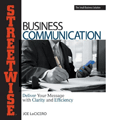 Joe LoCicero
Book: Streetwise Business Communication
Publisher: Adams
Pub date: February 2007
Agent: Jacky Sach
(Click to Buy)
Joe LoCicero is a Los Angeles-based author, TV writer, columnist, and marketing consultant. He has been integrally involved with the marketing strategy for hundreds of network and cable television programs, as well as numerous consumer products. He has put his marketing, publicity, and advertising skills to work launching his own family lifestyle company, PRACTICAL WHIMSY, which captures his other expertise: offering advice, products, and tips for family suppers, celebrations, and decorating.
Author Web site: www.practicalwhimsy.com
BookEnds: Describe your book in 50 words or less.
Joe: Gleaned and culled from my experience working for Fortune 500 companies, studios, and networks, Streetwise Business Communication canvasses the most effective, clearest way to deliver a company’s message by both traditional means (letters, memos, meetings) and newer modes (e-mails, Web sites, PowerPoints) that—when mastered—both save and make time and money for small businesses.
BookEnds: Why did you write this book?
Joe: I feel that—ironically—the more technologically savvy communication gets, the less people seem to truly know how to communicate. I wanted to reach out and influence anyone in a workplace to take a step back and analyze the best way to compose and deliver any message they’re trying to get out there. To communicate effectively with different audiences takes more than a little creativity, and I’ve been fortunate to be able to bridge both business and creativity often in my career. Having had experience on the publicity agency side, in the media, and working for Fortune 500 companies, I’ve been able to use that background to help small companies carve out their own niche in today’s highly competitive marketplace. That perspective, and having to use it for my own company, allowed me to understand how I could help other companies start, continue, improve, or change their communication modes and methods in everything from composing an e-mail and writing a business plan, to developing a press kit, drawing up an ad, outlining a speech, or designing a Web site.
BookEnds: What has been your most successful marketing campaign?
Joe: In the book world, I’ve only had one book out so far, which came out last year. And although it’s been my only marketing campaign to date in publishing, I’m very proud of it and what we’ve accomplished. I believe that—particularly in nonfiction books—there are a tremendous amount of pitching angles to explore. You just have to brainstorm . . . a lot. It also helps that my first job was writing obituaries for the Atlanta Journal-Constitution. Working in that newsroom environment, combined with pitching to entertainment media for Paramount and Turner Broadcasting, has given me a remarkable sense of knowing what does (and more important, what doesn’t) interest someone in the media. You have to suss out: “Where’s the story?” “Why do they care about it?” “And then: Will the resulting hit prompt someone to buy the book?” To that end, after writing The Complete Idiot’s Guide to Clear Thinking (Penguin 2005), I came up with literally dozens of angles, organized and categorized by what print and broadcast outlets might be interested in them. Even though “thinking” obviously has wide appeal, the angles themselves had to be very specific. But that approach paid off with many diverse outlets. Some of the hits included two articles in Cosmopolitan (on separate clear-thinking-related topics), SIRIUS’s Martha Stewart Living Radio, daily newspapers in the U.S. and Canada, education publications including George Lucas’s Edutopia magazine, Woman’s World, and several radio stations.
BookEnds: What’s your next book? When should we look for it?
Joe: I have two books coming up: the first, Cake Decorating for Dummies, is being released in April. That topic ties in with PRACTICAL WHIMSY, and gives instructions, ideas, and techniques for all kinds of celebratory cakes. And another Streetwise title, Streetwise Meeting and Event Planning, will be out in October. That one helps small businesses successfully handle initiatives that will increase sales or foster staff unity or establish them as a market leader, including holding a press conference, staging a grand opening, organizing a seminar, and launching a promotion.
BookEnds: What else are you working on?
Joe: I’m actually in the throes of several projects. Being a writer and small business owner brings lots of variety to every day. Since my wife and I run PRACTICAL WHIMSY, we’re constantly designing new products, working with our sales rep to make sure stores have what they need, keeping our Web site up-to-date, and testing recipes (which our two young kids help out with!). I also write regular columns for both Y’ALL: The Magazine of Southern People and momready.com. And with a background rooted in entertainment, I still occasionally take on a script-writing gig, which I find keeps me tapped into pop culture. I just finished writing episodes for a prime-time NBC series that’s based on a telenovela.
BookEnds: What are you reading now?
Joe:I kind of have eclectic tastes where reading for fun’s concerned, and I’m always in the middle of more than a few books. I almost always stick with nonfiction. I find that, often, those actually make for better stories than fiction. Since that’s what I write, I love reading how another author’s crafting what they’re relating. Right now, I’m immersed in Disney War, James B. Stewart’s account of the last two decades at the entertainment giant; Amy Sedaris’s I Like You, a giddy trip through her various (and sometimes unconventional) ideas for entertaining; Bina Abling’s Fashion Sketchbook, because I always like to be engaged in learning exercises, and her Parsons School of Design expertise on drawing is incomparable; and humorist James Thurber’s Thurber Carnival collection of short stories . . . because, amidst whatever and everything I might be working on, he always makes me laugh (and we all know how important that is).
Thursday, February 01, 2007
Reader Question: Author Meetings
I know you’ve done blogs on pitching and querying, but I haven’t seen anything about your first meeting with a new client. Do you ever meet with authors whose projects interest you but who you, in the end, decline to represent? Or do you only meet with authors you have already signed?
Well, to be honest, we don’t talk a lot about our first meeting with a new client because we have clients we’ve never met. I’m afraid, though, that there’s no rule as to who we’ll meet with and who we won’t. If I’m attending a conference I’m certainly open to meeting with authors I’ve rejected or those I still have under consideration. I’ll be honest, though: I’m less likely to do that during normal business hours. If I were to meet with every potential client, or all of those I receive submissions from, I would certainly have no time for anything else. Traditionally I will only take time out of my day to meet with clients who have already signed or those I have offered representation to and who want to meet face-to-face before making anything official.
Either way, what are some tips you could give to new authors meeting their agent/potential agent for the first time? What kinds of things should the author be sure to cover in that first meeting (i.e., would you consider it an opportunity for a longer pitch on their current novel, a discussion of works in progress, or more of a social venture to ensure that you’re “clicking”)?
Tips on meeting agents really depend on what stage you’re at. I’m going to avoid giving advice right now on meeting agents for a pitch since I think I’ve covered that fairly well in other posts. Instead I’m going to talk about meeting your agent for the first time and also give tips on interviewing agents in person if they have already offered representation.
If you have an agent already and are gearing up to meet her for the first time, I have two bits of advice. The first is to enjoy yourself. Get to know this person and have a good time. I love having the opportunity to sit with my clients over a drink or a meal and just talk about life and, of course, career. I think it’s good for both of us to have the time to get to know each other better. The second bit of advice is don’t be afraid to take notes. Face-to-face conversation can be so much better than phone or email, so take the time to really ask career questions and tell your agent your hopes, dreams, goals, and concerns. This is a terrific time to share your business plan with your agent and ensure that the two of you are on the same page.
As for those of you who might be meeting with a number of agents before choosing the one you want to make your own, I can only say trust your gut. I would suspect that if you’ve already gotten to this stage you’ve done your research and asked each agent the important questions—what is their commission percentage, do they work with a contract, etc.—so meeting in person is really your way of evaluating who you think you mesh best with and would like working with. To make that possible I think you have to ask additional career questions, but also just get a feel for how the two of you communicate and whether or not you click. In this particular instance you are no longer pitching; instead the agent is, and you should definitely enjoy the driver’s seat.
—Jessica
Well, to be honest, we don’t talk a lot about our first meeting with a new client because we have clients we’ve never met. I’m afraid, though, that there’s no rule as to who we’ll meet with and who we won’t. If I’m attending a conference I’m certainly open to meeting with authors I’ve rejected or those I still have under consideration. I’ll be honest, though: I’m less likely to do that during normal business hours. If I were to meet with every potential client, or all of those I receive submissions from, I would certainly have no time for anything else. Traditionally I will only take time out of my day to meet with clients who have already signed or those I have offered representation to and who want to meet face-to-face before making anything official.
Either way, what are some tips you could give to new authors meeting their agent/potential agent for the first time? What kinds of things should the author be sure to cover in that first meeting (i.e., would you consider it an opportunity for a longer pitch on their current novel, a discussion of works in progress, or more of a social venture to ensure that you’re “clicking”)?
Tips on meeting agents really depend on what stage you’re at. I’m going to avoid giving advice right now on meeting agents for a pitch since I think I’ve covered that fairly well in other posts. Instead I’m going to talk about meeting your agent for the first time and also give tips on interviewing agents in person if they have already offered representation.
If you have an agent already and are gearing up to meet her for the first time, I have two bits of advice. The first is to enjoy yourself. Get to know this person and have a good time. I love having the opportunity to sit with my clients over a drink or a meal and just talk about life and, of course, career. I think it’s good for both of us to have the time to get to know each other better. The second bit of advice is don’t be afraid to take notes. Face-to-face conversation can be so much better than phone or email, so take the time to really ask career questions and tell your agent your hopes, dreams, goals, and concerns. This is a terrific time to share your business plan with your agent and ensure that the two of you are on the same page.
As for those of you who might be meeting with a number of agents before choosing the one you want to make your own, I can only say trust your gut. I would suspect that if you’ve already gotten to this stage you’ve done your research and asked each agent the important questions—what is their commission percentage, do they work with a contract, etc.—so meeting in person is really your way of evaluating who you think you mesh best with and would like working with. To make that possible I think you have to ask additional career questions, but also just get a feel for how the two of you communicate and whether or not you click. In this particular instance you are no longer pitching; instead the agent is, and you should definitely enjoy the driver’s seat.
—Jessica
Subscribe to:
Posts (Atom)